
उद्भव (Udbhava): I Was Gym Fit, but Couldn't Last 15 Minutes": Inside a 40-Year-Old Tech Executive’s Martial Arts Transformation

A CXO's transformation from life threatening tumours to teaching kids the way of a warrior.
About उद्भव
उद्भव (Udbhava) is a series of conversations with students at Kombat Hall. Stories of people who chose to keep showing up and did not quit.
Through honest conversations, we explore उद्भव (Udbhava) or The emergence of one's truest self through consistent practice.
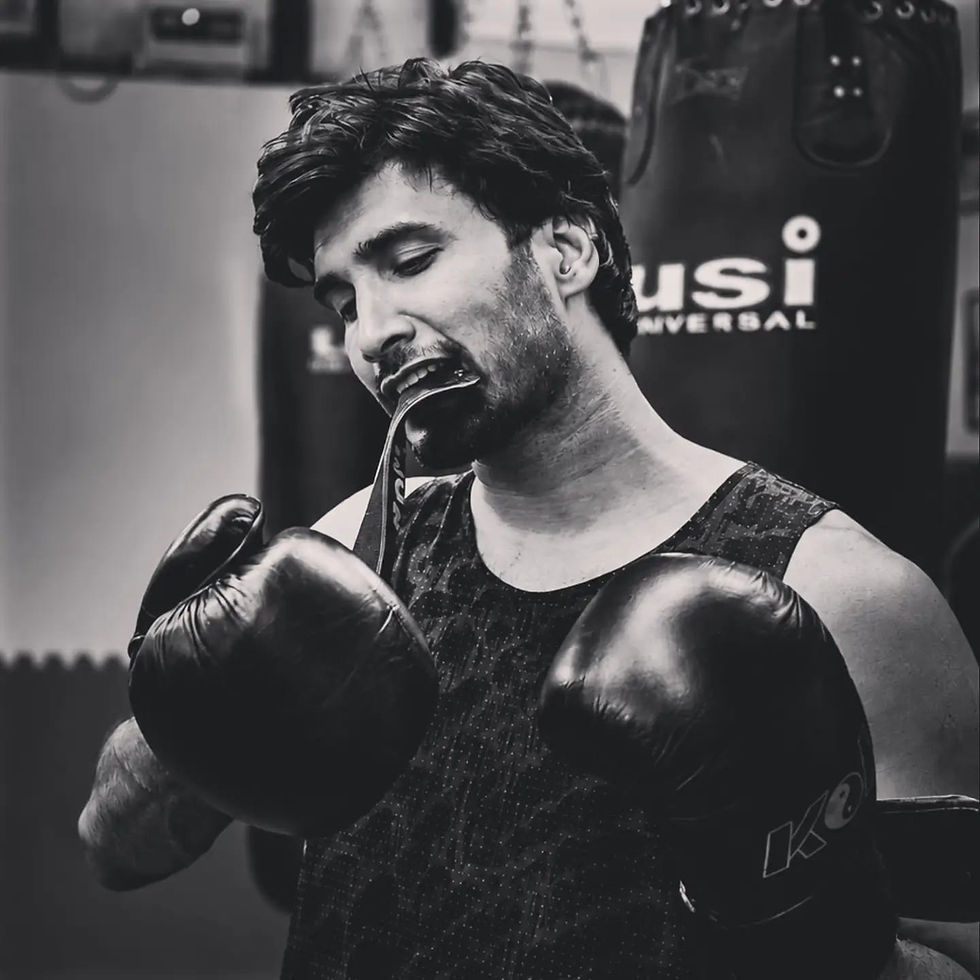
This blog covers the story of Himanshu, a warrior who went through life threatening tumours and discovered the way of a warrior with Martial Arts. Lets dive in:
Shikher: Hello Himanshu, a quick introduction for all the readers, please.
Himanshu: I am Himanshu, a 41-year-old who has experienced life from many angles. I have held a CXO position, leading US clients and managing deliverables in India. Aside from this, I have been active on the fitness side; I have been gymming regularly, but my stamina was poor, and my health markers took a hit. For almost the last four and a half to five years, I have been doing MMA and the regime here. So that’s a bit about me.
Shikher: How was your journey from a Rajasthan boy to a CXO?
Himanshu: I would say it had its own ups and downs—I was lucky in many ways and grateful to God. After completing my engineering, I moved to Faridabad. I was fortunate to get selected at Cisco. For two years, I was learning about networks, firewalls, cyber attacks, and security. After that, I moved on to manage infrastructure for bigger institutions, like Russian banks, and later worked with hedge funds.
I got to learn across different technology verticals. Soon after, I tried my luck in the cloud and data centers. I joined a company at a senior level. Proving myself against every challenge, I was promoted to Vice President, heading overall US deliverables. I worked there for nine years before moving on.

Shikher: When did your fitness journey start? What was your pull towards it?
Himanshu: I always liked being fit, though I only did light workouts at home. I tried joining the gym multiple times in my life, but the routine never stuck—either I lasted a month or dropped it entirely.
Between 2017 and 2018, I fell severely ill. Diagnosed with tumors, I was bedridden for almost a year and began to fear it was the end of my life. After coming out of that situation, I thought life might not give me another chance, and I had to get dead serious about my health.
I joined a gym and started accompanying my wife, which gave me initial motivation. But in 2022, I came to Kombat Hall. I realised gym fitness was mostly cosmetic muscle; what I truly needed was strength from within.
Shikher: What was the biggest difference you found between normal gym fitness and martial arts?
Himanshu: It's a huge difference. The gym can teach you how to build muscle, but it cannot give you real confidence under pressure. Furthermore, we don't usually push ourselves to unveil our body's true capacity—something I only discovered after joining Kombat Hall.
Shikher: Give me a specific example of this difference.
Himanshu: In the gym, I had the strength to do heavy squats, bench press, and bicep curls. But when I joined Kombat Hall, I couldn't last 15 minutes in high-intensity conditioning, which showed my body wasn't functioning as well as I thought.
In a gym, you typically do a set for a minute, rest for two or three, and walk away feeling done after an hour. Here, it's an entirely different reality.
Shikher: And how about the mindset difference?
Himanshu: There is no comparison. Martial arts train your brain on a completely different frequency. I developed a level of quiet confidence where even if I have to address a room of strangers, my heart rate doesn't spike. I can walk into any forum now.
The brain naturally triggers fear responses in high-pressure situations. Through consistent sparring, I've learned to master that response—controlling my focus, composure, and reactions instead of letting adrenaline dictate them.

Shikher: I used to take kickboxing classes in a gym before COVID. I remember bulky guys coming in with legs twice the size of mine. But with even a 50% power low kick, they would buckle: "Sir ji, yeh kya kar diya?" and go down. I used to wonder: what’s the point of having monster-looking legs if they can't absorb a basic kick.
Himanshu: Exactly, Sensei. People assume that being heavily built means you can handle anyone, even without knowing how to throw or take a strike. But in sparring, a clean punch or kick to the liver or solar plexus from a 60 kg opponent can fold an 80 kg person instantly.
Shikher: A bigger person can intimidate, but once the intimidation wears off and hands are thrown, it's a different game.
Himanshu: True. Martial arts strip your ego away.
Shikher: Someone who is properly trained in martial arts is rarely intimidated.
Himanshu: Right. You lose the urge to intimidate others, and you actively avoid street fights because you know the real damage that can happen to both sides. Once you conquer your ego, you win in life.
Shikher: Once you step onto the mats, size without technique offers very diminishing returns.
Himanshu: Being big doesn't mean you can last five rounds. Once you gas out, even a much smaller fighter will pick you apart.
Shikher: What’s your sparring experience been like?
Himanshu: A lot of fighters talk about how entering the ring brings absolute silence—the outside world disappears. That is completely true. That mental focus kicks in because the stakes are real. In sparring, there's no room to zone out; slip for a second, and you take a clean punch to the jaw.
Shikher: There is zero chance you are thinking about your boss or unpaid bills at that moment. You are 100% present.
Himanshu: Not a chance! If you aren't 100% there, you will pay for it immediately on the mat.
Shikher: Tell me about your initial days in martial arts. What made you start?
Himanshu: I never planned on joining a dojo; I was 35 when I started. But I knew you from your corporate days, and I had been following your martial arts journey and karate updates on Facebook for a long time. That inspired me. I wanted that lifestyle, but my corporate ego and "lack of time" kept getting in the way—until COVID and my health scare forced a reset.
One day, I saw your post, called you, and dropped by the academy. That single Kickboxing trial session shifted my perspective entirely. I knew right then there was no turning back.
Initially, I had the pride to think I could achieve in two years what took others ten. But I quickly learned that martial arts isn't about outperforming anyone else; it's an internal battle. You only have to outperform who you were yesterday. And it demands grit—you have to respect conditioning, active recovery, and proper rest

.
Shikher: Tell me about sessions that made you rethink things and helped you grow as a person.
Himanshu: I still hesitate to call myself a martial artist—there is so much left to learn.
Shikher: I need to interrupt you there: being a martial artist isn't defined by national medals or championship belts. A martial artist is someone who trains consistently under a qualified coach with dedication. By definition, you are one.
Himanshu: Then I can proudly say I have the best coach!
In the beginning, some days were rough. My body would ache, and family members would ask, "Why put yourself through this bashing? Every time we see you, you have new bruises."
Yet, it brings pure joy. Walking out of a tough session makes me feel like a kid again. I encourage anyone who hasn't tried martial arts to do so—it reconnects you with that fearless inner child and reveals what you're truly made of.
Shikher: You also competed in a championship bout. How did that go?
Himanshu: Competing wasn't on my radar, but my coach pushed me: "Why not test yourself?" Even though my opponent was significantly heavier, I agreed to give it a shot.
Inside the ring, all the anticipatory fear vanishes. It's just you and your opponent. While I didn't get the win, it gave me clarity: competition isn't purely about the scorecard. It’s about testing your heart and nerve under pressure when there’s nowhere to hide.
Shikher: A great learning experience.
Himanshu: Absolutely. I took that into regular sparring.
Even when taking heavy shots, your ego takes the first hit before your body does.
But thanks to our coaches, I rarely made the same technical mistake twice.

Shikher: Aman Sensei doesn't take it easy during sparring.
Himanshu: It's brutal! Every time in MMA class when I spar with Aman Sensei, I feel like a day-one beginner. I'll ask for feedback, feeling defeated, and he’ll tell me, "No, your movement was much sharper today."
Shikher: And then you spar with newer students and notice the difference.
Himanshu: Exactly—that's when it clicks. Looking back at training videos from five years ago, I see how raw and sloppy I was. The technical progress is night and day.

Shikher: Does this discipline translate outside the dojo?
Himanshu: Tremendously. I carry a quiet confidence when I'm out with my wife.
With my son, I can match his energy stride for stride—whether we're running sprints, playing table tennis, shooting hoops, or training calisthenics together.
My father never had the physical capability to play with me like that, and I don't see many parents keeping up with their kids at that level today.
Shikher: And you used to struggle physically?
Himanshu: Completely. Early on, my wife was far fitter than me—she crushed me at planks, squats, and chest presses. She was my trainer when I first stepped into a gym. Now, I can comfortably out-train both my son and my wife.
Shikher: Not many husbands dare say they can subdue their wife!
Himanshu: Strictly in fitness, Sensei! 😀
Shikher: How has your mindset shifted regarding street altercations?
Himanshu: I got into my fair share of street fights before joining the academy. In fact, learning self-defense was one of my original motivations.
Now, I have the confidence to walk away instantly. When you know how easy it is to cause catastrophic injury with a single clean shot or a fall onto concrete, you realise street fights are foolish. Real confidence is being able to de-escalate and walk away without needing to prove anything.
Shikher: Who are some of your favorite sparring partners here?
Himanshu: Aman Sensei is always number one—he keeps me humble and sharp. Beyond him, Narayan has been an incredible partner who absorbs techniques rapidly. Shankar brings great technical pressure. Chetan, Kevin, Tarun, Manu, Kabir, and Jasnoor—the whole mat crew makes everyone better.
Shikher: What is your advice to someone hesitant about starting their fitness journey?
Himanshu: Stop overthinking and just step through the door. People waste months debating whether Muay Thai, Brazilian Jiu-Jitsu, or Kickboxing is right for them. Pick a class, show up, feel the movement, and adjust along the way.
Too many people treat martial arts like a 30-day crash diet. It isn't a temporary fitness phase; it's a lifestyle transformation. Our coaches train six to seven hours a day, constantly refining their craft. If you integrate yourself into that discipline, the personal growth and joy you get back are unmatched.
Shikher: You recently started teaching the kids' batches. How has coaching treated you?
Himanshu: I love it. Teaching kids forces to refine fundamentals. You can't rely on brute force; you have to break down posture, weight distribution, and balance to their simplest components. Spotting their technical errors keeps me from making those exact mistakes in my own sparring. It's helping me evolve both as a martial artist and as a coach.
Shikher: Any closing thoughts for your teammates at Kombat Hall?
Himanshu: Life moves like a volatile market chart—there will always be peaks and valleys. Don't let downswings derail you. If you put the work in during the low points, you set yourself up for heights you haven’t seen yet. Train hard so you can enjoy your life and stay active with your kids for decades to come.
Shikher: And if you are a kid, training makes you a grounded adult.
Himanshu: Exactly. I often sit with Vivaan to talk about character, discipline, and standing up for himself. That mindset shifts everything.
Shikher: Thank you, Himanshu!
Himanshu: Thank you, Sensei!
Editor's Note:
This interview has been lightly edited for clarity and readability. Filler words, repetitions, and obvious transcription errors have been removed, but every answer faithfully reflects the student's own words and experiences.


Comments