
When the Client is the Predator: A Corporate Self Defense Workshop

Updated: Mar 8
A specialised workshop for domestic service professionals
"I’ll give you the OTP once you finish peeling the vegetables." The door was locked. Her phone was snatched. She was trapped in a washroom, held hostage by a client who decided that an “on-call service” was actually a license for forced labor. This isn’t a script from a thriller; this was a story shared by a woman sitting in our workshop this week.
When we sat down with the women domestic service professionals during corporate self defense workshop, to brainstorm the "problems" they face, the floodgates opened. It wasn’t just about "difficult clients"—it was about surviving predatory environments where the power dynamic is skewed from the moment they step over the threshold.

The Stories We Don’t Hear
As a martial art, I’ve spent my a significant portion of life studying aggression. But hearing these women talk about their "office" was a sobering reality check. These are lived horrors happening in luxury apartments and gated villas:
The Gang Ambush: Entering a house to find 5 men drinking and getting aggressive—a professional job turned into a high-risk ambush in seconds.
The "Theft" Excuse: An employer that too a women, ordering a woman to undress completely to "check for stolen items"—a disgusting tactic designed to strip a woman of her dignity and agency. They were not safe in a women run house was something unbelievable. She wanted to create a video of her.
The High-Society Predator: One maid shared an instance from a one of the most premium societies in Gurgaon where a wealthy resident tried to force on her. She somehow escaped, and the wealthy resident then blamed her for stealing cash. However, the company stood by her and reported it to the police, the man finally accepted his fault and was taken to task.
Beyond the Boardroom: Designing a Corporate Self Defense Workshop for High-Risk Environments
When we were approached to design this session, we knew it couldn’t be a "standard" corporate self defense workshop. In a typical office setting, "danger" is usually not in the face every time.
For these women, the danger is in the kitchen, the bedroom, and the balcony.
A member of the organising company was nervous. “What if we teach them too much? What if they use these moves to overpower an elderly client and steal?” It’s a fear rooted in the "bad apple" narrative—the idea that a thousand good women should be left defenceless because of the potential actions of a few.
My take? You don't leave a soldier unarmed because you fear they might desert. A predator doesn't need "techniques" to cause harm; they use size, surprise, and isolation. But a woman with no training is a sitting duck. We weren't teaching them to be aggressors; we’re teaching them be able to escape every situation.
By focusing on escape rather than assault, we provided a responsible framework for empowerment.
Mapping the Danger: The Color Code of Survival
We didn't waste time on flashy moves. We worked on a "Colour Code" of survival that helps them identify a threat before it becomes a struggle.
Yellow Zone (The Red Flag): If a client stands in the doorway, alert the company now. If the "Madam" of the house isn't home as promised, leave now. Keep an equipment in between always.
Red Zone (The Contact): When a hand touches the waist or the door locks, the "polite worker" must disappear and the "warrior" must take over.
The Drills: Making Survival a Muscle Memory
Theory is useless without the sweat of application. Every attendee worked through the adrenaline of real-world scenarios, mastering the application of techniques under pressure:
Dragging Attempts: Learning how to use stance and body movement to become "heavy" when someone tries to pull them into a room. Ensuring they could get rid of the strongest wrist hold.

Mastering the "Wrist Peel": Simple, effective escapes from forceful grabs.
Hair Pulls: Drilling the immediate reaction to pivot to escape. Instead of running and taking damage as a natural reaction.

Neutralising the pull: Training to regain control during a hair-drag attempt.
Bear Hugs & Forceful Grabs: Simulating being grabbed from behind while cleaning and learning to "peel" wrists to break the hold.

Dropping the base: How to become "heavy" and break a bear hug from behind.
The Pin: Practicing what to do if they are pinned to the floor or a wall—learning to create "frames" to keep an attacker’s weight off and using their hips to create an exit window.
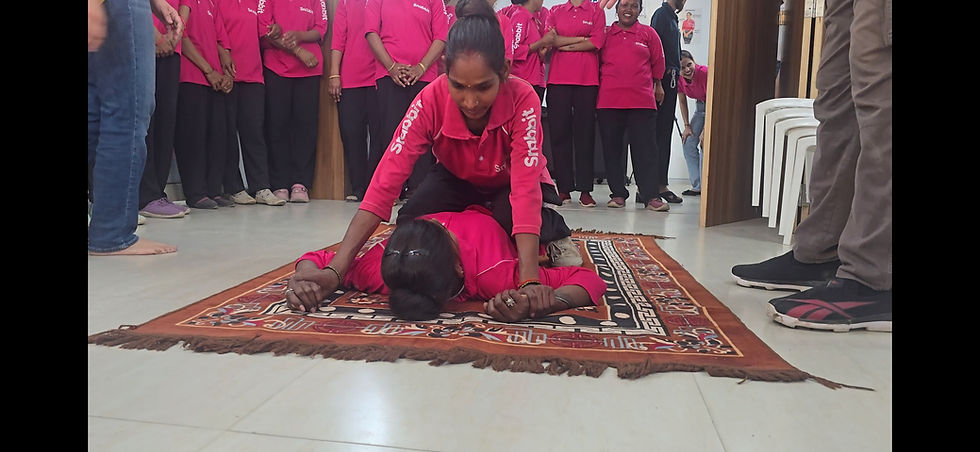
The Great Escape: Learning BJJ-based frames to create an exit from a floor pin. 
Restoring the breath: Rapid response techniques for neck and throat grabs.
The Witness Strategy: Breaking the Silence
We taught them that their Voice is a tactical weapon. A predator’s greatest tool is the victim's fear of "making a scene" or being accused of a crime.
We gave them a clear directive: Make noise. Shout to the guards, the neighbours, or anyone within earshot (if available). This isn't just about getting help; it’s about legal self-defense. By being loud, they create a witness trail that prevents a client from later claiming "she was stealing" as a cover-up for his own harassment.
A Unified Front: The Role of the Police
A vital component of this corporate self defense workshop was the presence of senior lady police officers. Their involvement was a game-changer. They gave the women a direct assurance: "The police are here to help." They appreciated the initiative, reinforcing that when a worker reports an incident immediately, the law has their back.
Seeing the police and the training academy standing on the same side of the mat gave them a sense of security they had never felt before. It bridged the gap between the street and the station, proving that they are not alone.

The Moment of the Day: The Handshake
By the end of the session, the transformation was palpable. But the real "moment of the day" didn't happen during a drill.
After the workshop, a group of these new warriors came running up to our senior female student who had volunteered to help. They didn't want to learn another strike or another escape. They wanted to shake hands with her and acknowledge a strong women.
They had spent their lives bowing, shrinking, and avoiding eye contact. But after seeing how powerful a woman can be when she trains—after seeing our senior student move with confidence and strength—they wanted a piece of that power. They wanted to know how to look someone in the eye, reach out, and grip a hand with the firmness of an equal.
That, for me, was the victory. We didn't just teach them to survive an attack; we taught them that they deserve to occupy space.

A Question for the Readers: Where Do You Draw the Line?
While we focused on escapes and creating distance, there is always a debate in the martial arts community about the level of force taught to high-risk groups.
What is your view on teaching "chokes" or high-impact neutralizing moves to this community?
Do you believe that in a "closed-door" environment where she might be overpowered (like the molestation scenario), she should have the knowledge to completely incapacitate an attacker?
Or
Do you agree with the corporate concern that teaching "offensive" moves carries too high a risk of misuse?
Is it better to be safe and "limited," or is a restricted defense no defense at all?
I’d love to hear your thoughts in the comments.
This is a conversation we need to have if we are serious about protecting the women who power our homes.
Love and Peace, Shikher

I resonate with the words, "one rotten apple" should not make the others "sitting duck" in the various scenarios presented in the column. These women enter their workspaces to bring order to the place we call "home". Its a high time that their workspaces are as safe as we want our corporate offices to be. If not, they should have the means to stand up to the perpetrators on their own. They should taught to be resilient but should be able to take a stand wherever necessary.
Kudos to the team for empowering one of the most invisible workforce with most visible results in our daily life....